DHI vs FUE Hair Transplant
An objective, evidence-based clinical comparison of Direct Hair Implantation (DHI) and Follicular Unit Extraction (FUE). Understand graft handling, incision mechanisms, candidate profiles, and procedural trade-offs.
Direct Answer: Which is Better, DHI or FUE?
Neither technique is universally "better." DHI excels for hairline design, localized density enhancement, and unshaven procedures where maximum control over follicle angle is critical. Sapphire FUE is generally superior and more cost-effective for extensive Norwood 5–7 cases requiring 3,500 to 5,000+ grafts in a single operative day. Many modern Istanbul clinics also perform hybrid surgeries, combining FUE for the crown with DHI for the frontal hairline.
Comprehensive DHI vs FUE Comparison Table
| Clinical Parameter | DHI (Direct Hair Implantation) | Standard / Sapphire FUE |
|---|---|---|
| Extraction Technique | Micro-FUE punch (0.7mm – 0.85mm) | Micro-FUE punch (0.75mm – 0.90mm) |
| Recipient Channel Creation | Simultaneous: Choi Pen needle creates the slit and deposits graft concurrently | Separate Step: Surgeon opens all slits with sapphire or steel blades beforehand |
| Graft Handling | Follicle loaded into pen; dermal bulb protected inside needle shaft | Grafts inserted into pre-cut incisions using micro-forceps |
| Out-of-Body Duration | Shorter (often implanted within 30–60 minutes of harvesting) | Moderate (grafts stored in solution until all channels are opened) |
| Hairline Density Capability | Very High (up to 55–65+ grafts/cm²) | High (typically 40–50 grafts/cm²) |
| Angle & Direction Control | Exceptional precision (360° rotational control with Choi Pen) | Dependent on pre-cut slit angulation |
| Recipient Shaving Requirement | Optional: Can be performed unshaven between native hairs | Usually requires shaving the recipient scalp to map canals |
| Maximum Grafts in 1 Session | 2,500 – 3,500 grafts (technically labor-intensive) | 3,500 – 4,500+ grafts (faster placement phase) |
| Average Package Cost in Istanbul | €1,800 – €4,500 | €1,500 – €3,200 |
| Scab Recovery Time | 7 – 10 days | 10 – 14 days |
Graft Extraction: Identical Origins
It is a common misconception that DHI and FUE use completely different harvesting procedures. In fact, both techniques harvest grafts using Follicular Unit Extraction (FUE). In both procedures, individual follicle clusters are extracted from the permanent donor region at the back and sides of the head using a motorized circular micro-punch.
The true divergence occurs during the implantation phase: how and when the follicle enters the thinning recipient scalp.
The Implantation Mechanism: Forceps vs. Choi Implanter Pen
In standard FUE or Sapphire FUE, the procedure is distinctly two-step:
- The surgeon cuts thousands of microscopic slits (channels) across the recipient area.
- Technicians subsequently use manual micro-forceps to grasp each graft and slip it into an open slit.
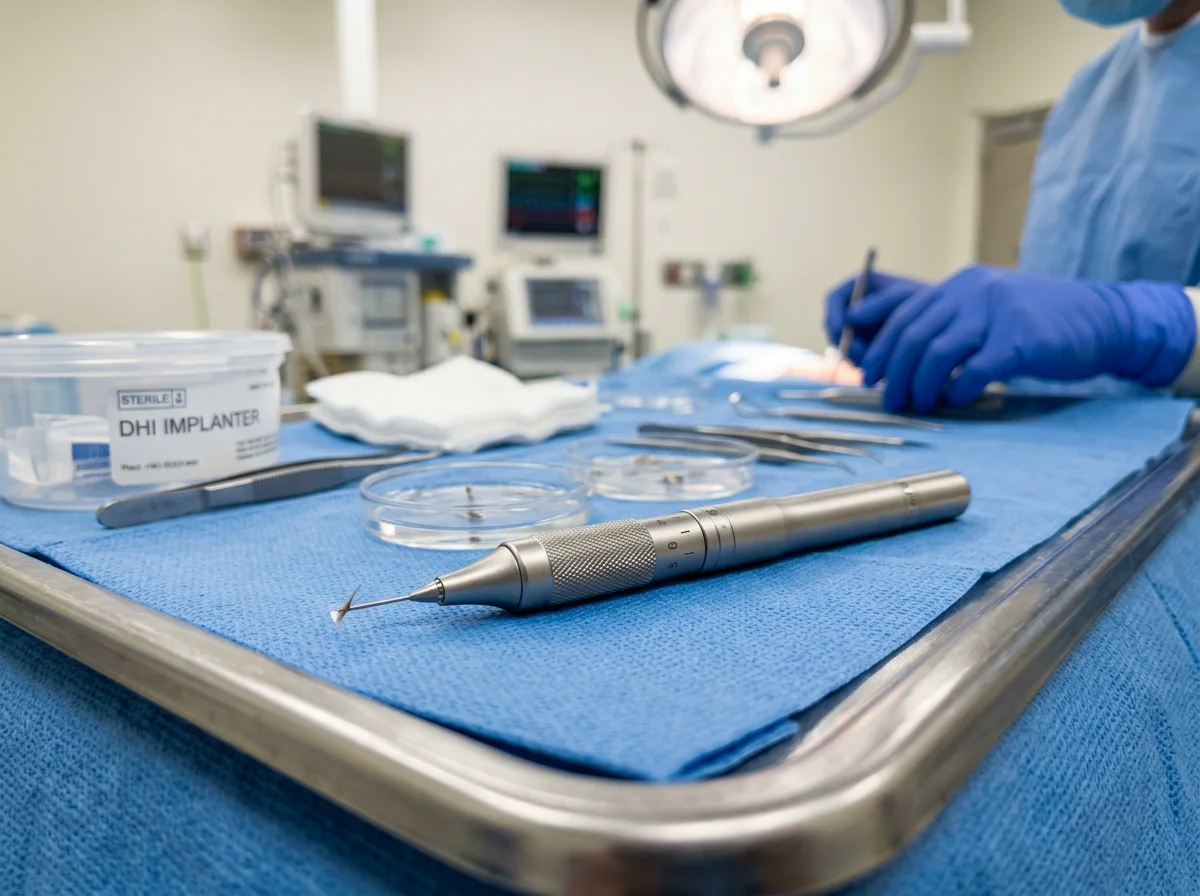
In DHI, the Choi Implanter Pen combines these actions into one fluid movement. Because the follicle bulb is encased within the steel needle, forceps never touch the delicate root during insertion, eliminating mechanical pinch trauma.
Watch: Clinical Overview of DHI Implantation
This educational video demonstrates how the Choi Implanter operates in clinical surgery and why it differs from conventional canal opening.
When is DHI the Preferred Option?
- Refining the Frontal Hairline: When building sharp, natural temple peaks and a feathered transition zone, the directional precision of the Choi Pen is unmatched.
- Crown or Mid-Scalp Densification: When existing native hairs are still present, DHI allows clinicians to slip new grafts between native strands without damaging neighboring roots.
- Unshaven Procedures (U-FUE / U-DHI): For female patients or working executives who cannot shave their existing hair for personal or professional reasons.
- Facial Hair Restoration: Beard, mustache, and eyebrow procedures require exact acute angles (10°–20°), making DHI the industry benchmark.
When is Sapphire FUE the Preferred Option?
- Extensive Hair Loss (Norwood 5, 6, or 7): Patients needing complete scalp reconstruction require high graft volumes (4,000–5,000 grafts). FUE enables the surgical team to cover large surface areas more rapidly.
- Budget Optimization: Because Sapphire FUE does not require multiple sets of single-use Choi pens, clinics can offer lower total package prices while maintaining high surgical quality.
- Coarse, Curly, or Afro-Textured Hair: Very curly hair roots can sometimes curve within the subcutaneous tissue, occasionally making Choi pen needle loading more complex than manual forceps placement.
Frequently Asked Questions
Is DHI better than Sapphire FUE?
Neither technique is universally superior. DHI offers superior angle and density control for hairlines and allows unshaven procedures. Sapphire FUE is often superior and more cost-effective for extensive balding areas (Norwood 5–7) requiring 4,000+ grafts in a single session.
Does DHI heal faster than FUE?
DHI typically produces slightly smaller puncture wounds and less tissue bleeding because channel incision and implantation happen simultaneously. Most DHI patients experience faster scab shedding (8–10 days) compared to standard FUE (10–14 days).
Can I combine DHI and FUE in one surgery?
Yes. This is called a "Hybrid" hair transplant. Many Istanbul surgeons utilize Sapphire FUE to efficiently cover the crown and vertex, while utilizing DHI to craft a dense, refined frontal hairline.
Find Out If DHI or FUE is Best For You
Submit your details for a free, non-binding clinical evaluation by certified Istanbul hair restoration doctors.